
Minidoka Scheduled Versus Actual Release
A scheduled date describes a future possibility or sentence endpoint. An actual release date records a completed custody event. Idaho records also separate eligibility for parole, a tentative parole placement, release to supervision, and final sentence satisfaction. These dates can be months or years apart. Preserve each source label.
A Mini-Cassia pretrial detainee has no fixed projected release date. Bond, a dismissal, a court order, unresolved warrants, detainers, and jail processing can all control the exit. A detainer is another authority's request to hold or transfer the person. A sentenced county detainee may have a calculable term, but no official local source publishes a universal county good-time or weekend-release formula.
Find Minidoka Projected Release Dates
Start with the judgment and custody type. A Minidoka case can remain in the Fifth Judicial District even when the person is housed in Burley or an IDOC prison elsewhere. Follow this order:
- Use Idaho iCourt to identify the case, sentence, fixed term, and later orders.
- For Mini-Cassia custody, call 208-878-1000 and ask which order or calculation controls.
- For state custody, search IDOC by name or IDOC number and verify birth year.
- Read every date by its exact label, including eligibility, hearing, and satisfaction dates.
- Check the Commission schedule and decision for any tentative parole action.
- Confirm release through a later In community record and Released to Supervision field.
The Idaho iCourt Portal can show the judgment, bond, disposition, and register of actions. The IDOC Resident/Client Search serves state jurisdiction only. A person who leaves Mini-Cassia on bond may never appear there.
Idaho Release-Date Vocabulary
Idaho's public IDOC detail does not use the generic field “Projected Release Date.” That absence is important. The official record uses several narrower labels, and the Commission supplies another. Substituting a generic label would hide whether a date is an eligibility point, sentence endpoint, or actual placement.
| Idaho field | Meaning |
|---|---|
| Parole Eligibility Date | Earliest ordinary parole consideration after the fixed term, not a promise. |
| Next Parole Hearing Date | A scheduled hearing that may change. |
| Tentative Parole Date | A conditional Commission date dependent on required steps. |
| Released to Supervision | The date IDOC reports placement in the community on parole or probation. |
| Sentence Satisfaction Date | The stated sentence or jurisdiction endpoint. |
| Discharged [date] | The date IDOC jurisdiction ended after sentence satisfaction. |
The official IDOC detail example demonstrates Parole Eligibility Date, Next Hearing, and Sentence Satisfaction Date.
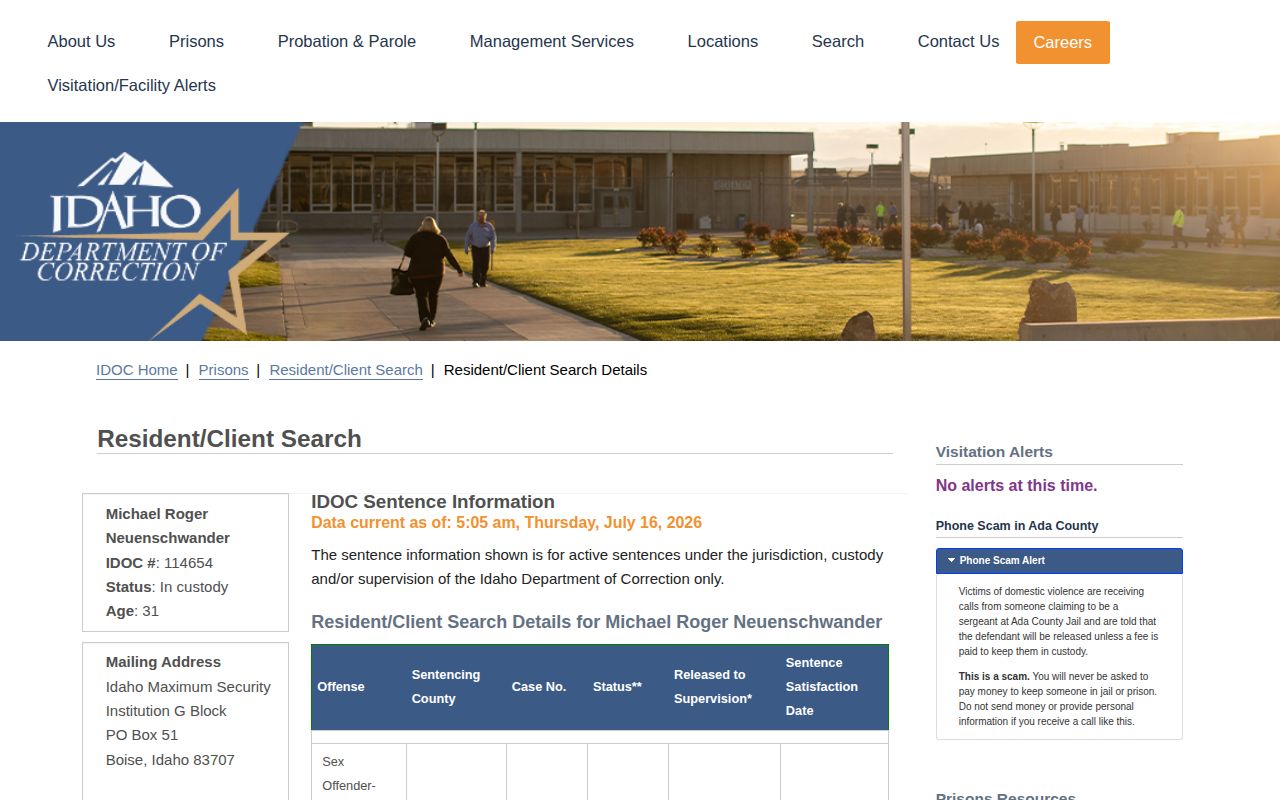
The image shows why the field names must remain distinct instead of being condensed into one predicted release date.
Minidoka Sentence Date Rules
Idaho Code §19-2513 uses a unified felony sentence. The court sets a determinate, or fixed, minimum period and may add an indeterminate period. The fixed part ordinarily must be served before parole eligibility opens. Mandatory minimums, enhancements, and consecutive sentences can make more than one minimum controlling. Parole remains discretionary during the indeterminate part.
Idaho has no general rule that a state prisoner serves about 85 percent through routine good-time credit. The fixed minimum is ordinarily served at 100 percent. Section 20-101D permits a narrow meritorious reduction for exceptional life-saving or similar service. It is not monthly credit for ordinary good behavior and can be withdrawn. Section 19-2513 also recognizes a separate medical-parole exception.
A fixed-life sentence or a sentence without an indeterminate portion has no ordinary parole window. The judgment and any offense-specific mandatory term control. Estimate nothing from the charge name alone.
Changes to Minidoka Release Dates
Apparent changes often reflect two sources measuring different events. Other changes are substantive. Read the reason before treating a newer date as a correction.
| Factor | Possible effect |
|---|---|
| Consecutive sentences | Multiple fixed terms may run in sequence before eligibility. |
| Parole decision | A denial or continuation delays possible placement. |
| Programming or plan | An incomplete program or unapproved plan can delay a tentative date. |
| Paperwork and transport | Release cannot occur before final processing is complete. |
| Hold or detainer | The person may transfer to another custodian instead of entering the community. |
| Violation or return | A new custody episode may produce a later Released to Supervision date. |
| Data lag | Online status may trail the agency's operational record. |
The Commission's posted decisions expressly treat dates as tentative. Required programming, an approved parole plan, paperwork, transportation, contract completion, and signature can remain outstanding. The decision can explain a grant, denial, continuation, rescission, or revocation, but only a later status proves placement.
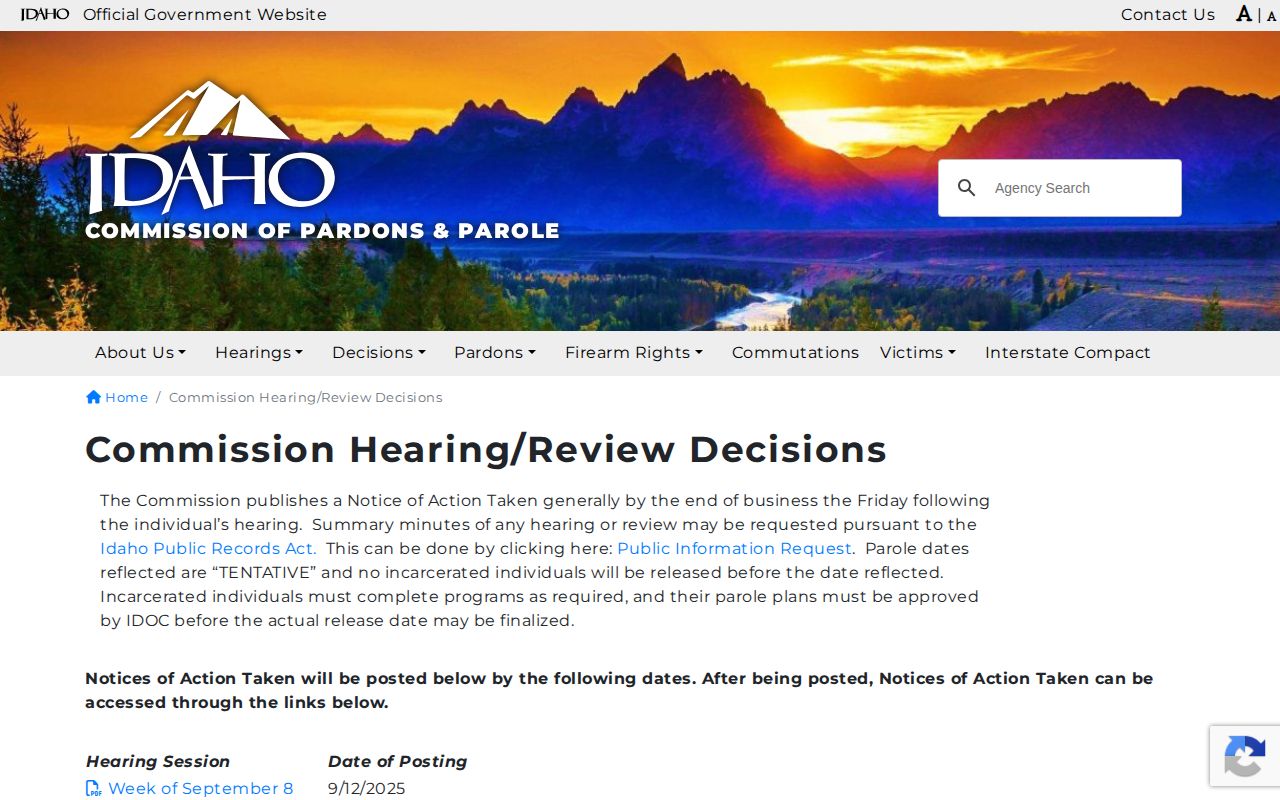
The decision page supplies conditional parole information rather than a guaranteed physical exit time.
Minidoka County Jail Calculations
County-jail release timing follows a different path. A bond release depends on all charges, court authorization, holds, and processing. One zero-dollar bond line or one posted bond does not settle the rest of the booking. A time-served release depends on the judgment, custody credit, and the jail's calculation. No verified Mini-Cassia source publishes a broad good-time formula or a rule that moves all weekend or holiday releases.
Idaho's unified-sentence statute should not be applied mechanically to every stay at Mini-Cassia. Section 19-2513 describes the fixed and indeterminate structure of a felony sentence in state jurisdiction. A short county sentence, pretrial detention, bond release, or time-served order can follow a different calculation. Obtain the signed judgment or release order, then ask the jail which custody credits, holds, and processing steps control that specific booking. If the court order and jail estimate differ, ask whether one date reflects legal authority while the other reflects the expected physical exit after final checks.
Ask Mini-Cassia for the actual release date and time, disposition, and whether the exit was to the community or another authority. Pair the response with the signed court order. If the roster name disappears, do not treat that absence as release. Mini-Cassia houses county, IDOC, ICE, USMS, and courtesy prisoners, so transfer is a real alternative.
Note: The Rupert sheriff office is a records location, not the current adult release door; adult Minidoka detainees are housed at Mini-Cassia in Burley.
Confirm Minidoka Actual Release Dates
For state custody, the strongest public confirmation is an IDOC In community detail with Released to Supervision. Later, Discharged [date] confirms sentence satisfaction and the end of IDOC jurisdiction, not necessarily the earlier prison exit. Request an IDOC record when the physical departure date and online field differ.
For county custody, use the Mini-Cassia custody-release entry. A court order explains legal authority, while the jail log records operational release. A VINE alert can provide timely notice but is not a permanent archive. Registration steps are covered in the Minidoka County VINELink check.
- Determinate term
- The fixed minimum confinement ordered by the court.
- Indeterminate term
- The later sentence portion during which parole may be considered.
- Parole
- Conditional community placement before final sentence discharge.
- Discharge
- The end of the corrections agency's jurisdiction.
The Idaho Commission publishes a hearing schedule and later Notices of Action Taken. A schedule identifies a planned hearing, not an outcome. Search IDOC first to get the correct IDOC number, then locate the matching hearing week. Dates and hearing order can change. Afterward, read the exact result. A notice may grant, deny, continue, rescind, or revoke parole, but a grant can still carry only a Tentative Parole Date. Programming, an approved plan, paperwork, and transport can delay placement.
When dates disagree, ask what each source measures. A filing can precede the signed order, and the order can precede jail departure. IDOC may update after transport. Compare booking ID, IDOC number, birth year, case number, and sentencing county. Same-name records must not be merged. For physical release, rank the custody-release log above roster absence. For a future state date, use current IDOC fields and the exact Commission decision above an informal estimate.
Ordinary parole eligibility also depends on the judgment. The determinate term must be fulfilled, and an indeterminate part must exist. Eligibility creates a chance for Commission review, not a right to leave custody. A fixed-life term, an unsatisfied mandatory minimum, or a sentence without an indeterminate portion prevents the ordinary parole path. The signed judgment and offense statute control.
A discharged IDOC result may retain the person's name, number, birth year, status, and discharge date while completed conviction details no longer display. Use the Minidoka iCourt case to identify the conviction and sentence. Request IDOC records when the actual institutional exit date is needed. The person may have entered the community earlier on parole, so the later discharge date must not replace Released to Supervision.
Compare identifiers and “as of” times whenever records seem to conflict. A judgment date, hearing date, tentative parole date, jail departure, and IDOC update can all be accurate while describing different stages.