
Federal BOP Minidoka Release Paths
The Federal Bureau of Prisons holds people serving federal sentences. It does not operate the Mini-Cassia Criminal Justice Center, and no BOP institution was found in Minidoka County. The local connection arises when a federal case leads to USMS custody, temporary contract housing, sentencing, and later BOP designation. Local joint-powers minutes separately counted USMS prisoners at Mini-Cassia, which shows that a person can leave the regional jail without entering the community.
A BOP release can lead to the community, court-ordered supervision, or custody by another authority. “RELEASED” means the person is no longer in BOP custody. It does not rule out a state warrant, ICE custody, a new jail booking, or another legal obligation. The federal docket explains the judgment and supervised-release conditions. The locator answers the narrower BOP custody question.
Search Federal Minidoka Release Records
The BOP Inmate Locator covers federal records from 1982 forward. A number search is usually more precise than a name search. BOP accepts its register number and certain FBI, DCDC, or INS identifiers. Name searches can be narrowed with age, race, and sex.
- Confirm that the case is federal through the court docket or USMS path.
- Open the BOP locator and search by register number when known.
- Otherwise enter first, middle, and last name with available refinements.
- Compare the register number, age, race, and sex with the known person.
- Read the location and release-date fields exactly as displayed.
- Check the federal docket when the result needs legal context.
A past release date and “RELEASED” or no BOP institution support the conclusion that BOP custody ended. A future release date is projected and can change. Sentence recalculation, including applicable First Step Act calculations, may affect it. Never turn a projected date into a completed event.
The official BOP locator result demonstrates the federal release-date and location fields.
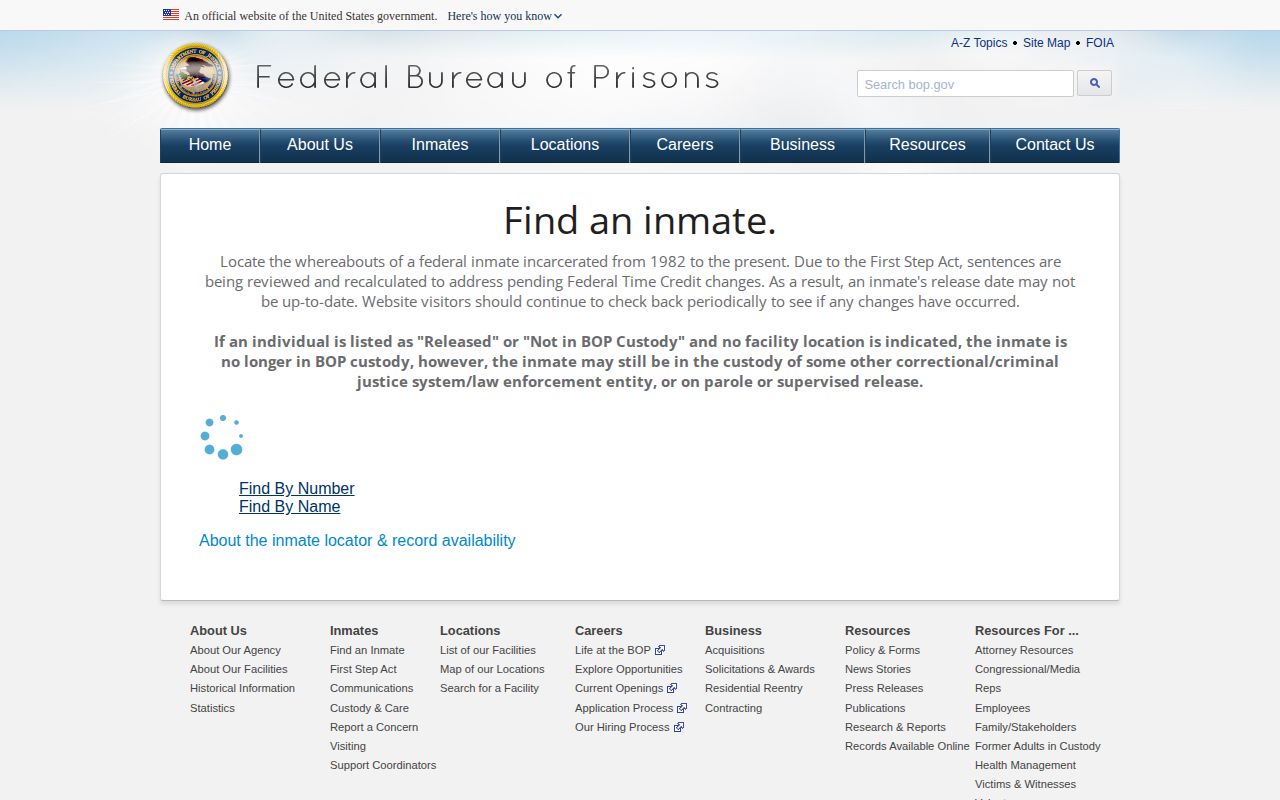
This federal result should be matched to the federal case and does not describe an ordinary Mini-Cassia county release.
Federal Release Result Fields
Read the result as a compact custody record. Each field narrows identity or BOP status, but no single name match is enough.
| Field | Use |
|---|---|
| Name | Identity as recorded by BOP. |
| Register number | The most useful BOP-specific identifier. |
| Age, race, sex | Comparison fields for same-name results. |
| Release date | Past or projected date tied to BOP custody. |
| Location/status | Institutional location or indication that BOP custody ended. |
BOP explains that “RELEASED” means no longer in BOP custody. It does not mean the full federal case disappeared. Supervised release is a court-ordered period after imprisonment and is distinct from BOP incarceration. The docket remains the source for those terms, later court action, dismissal, acquittal, time served, or sentence information.
- BOP custody
- Federal imprisonment administered by the Bureau of Prisons.
- USMS custody
- Federal pretrial or transport custody that may use contract jail beds.
- Designation
- Assignment to a BOP institution after a federal sentence.
- Supervised release
- Court-ordered federal supervision after imprisonment.
Mini-Cassia Federal Transfers
Mini-Cassia's dated joint-powers minutes document USMS prisoners in the regional center. A federal defendant may be housed there before trial, sentencing, transport, or BOP designation. The building is operated by Cassia County Sheriff, but the legal custodian may be federal. That distinction controls the record request and the meaning of an exit.
When a name leaves the local roster, call Mini-Cassia at 208-878-1000 and ask whether the matching booking ended through community release or transfer. If USMS received the person, check the federal docket for the next hearing or judgment. BOP may show nothing until designation. It may never show a person whose federal case ended without a BOP commitment.
The sequence is therefore local roster and jail confirmation, federal docket, USMS custody follow-up, and BOP only when a federal sentence or designation supports it. These sources describe stages, not competing versions of one event. The Minidoka County released inmate search covers county, state, federal, and immigration reconciliation for a named person.
Federal Historical Release Records
For BOP records before 1982, follow the locator's direction to the National Archives and Records Administration. For a modern result, BOP can answer the public locator question, but a more detailed release or sentence record may require an agency request. Provide the full name, register number, date range, institution if known, and the exact fields needed.
USMS has no public historical person locator comparable to BOP. Its FOIA page identifies prisoner records and the Prisoner Tracking System as possible record sources. A focused request should name the individual, date range, requested custody or transfer information, and desired format. Privacy and law-enforcement exemptions may restrict disclosure.
Use the federal court docket for the legal chronology. It can distinguish acquittal, dismissal, time served, sentence, and supervision. Use the housing agency and USMS for the custody chronology before designation. Use BOP for the later sentenced-custody and release record. A missing BOP result is inconclusive if the person never reached BOP or the record predates locator coverage.
Confirm Federal Minidoka Releases
Confirmation starts with identity. Compare the register number and biographical fields to the federal case. Next, note whether the locator date is past or future and whether a location remains. A future date is an estimate. A past date with “RELEASED” confirms only the end of BOP custody.
If another custodian may be involved, follow it. ICE has its own locator. Idaho state custody belongs in IDOC. A new county booking belongs in the relevant jail roster and release record. No federal result should be used to infer the status of those systems.
For an exact physical departure time, transition destination, or discrepancy, seek the BOP or USMS record rather than estimating from the docket. Court orders can authorize or explain a change but may not record the moment transport or release occurred. Keep the source label beside every date.
Note: BOP release and completion of federal supervised release are separate events and should not be reported as the same date.
Reconcile BOP Dates and Custody
Several federal dates can appear near one another without measuring the same event. The judgment date records court action. A USMS movement date can mark transport between contract beds or delivery to a designated institution. A BOP locator date can be a past release or a future projection. Supervised release begins under the judgment after imprisonment, while its later completion remains a court and supervision matter. Preserve every source label instead of reducing them to one generic release date.
Start reconciliation with the federal case number and BOP register number. Compare the person's name and biographical fields, then note the source's update date and scope. If Mini-Cassia reports transfer to USMS but BOP still has no match, designation or data entry may not have occurred. The federal docket can show whether a sentence was imposed, but only the relevant custody agency can explain the person's present location or a completed physical movement.
| Apparent conflict | Check next |
|---|---|
| Local roster absence and no BOP result | Mini-Cassia, federal docket, and USMS custody record |
| Future BOP date and new court action | Current locator, judgment, and any recalculation record |
| Past BOP release but possible ICE or state hold | The specific ICE, IDOC, or county custodian |
| BOP release date and supervision question | Federal judgment and probation-office record |
Do not choose the earliest date because it seems to fit the expected release. First determine what each date represents. Then ask the agency holding the underlying record to explain a true discrepancy. A precise statement says that BOP displays a person as released from BOP custody on the shown date, while separately identifying any supervision or other-agency status that has been verified.
Identity Checks for Federal Releases
Federal identity checks should begin with the register number when one is available. Names can be shared, misspelled, changed, or entered with different middle-name formats. Compare the BOP number with the federal case, age, race, sex, and any USMS or Mini-Cassia identifiers. If a name search produces several candidates, do not select one solely because the release date seems plausible. Return to the docket or agency record for a firm identifier.
Record the result exactly as displayed, including whether the date is past or future and whether a location appears. When sharing a conclusion, state the date checked because BOP projections and locations can change. If an agency later corrects a result, preserve the corrected source rather than blending old and new values. Careful identity matching prevents a federal release record from being attached to the wrong Minidoka-connected person.