
Minidoka Parole Versus Probation
Parole and probation both place a person in the community under rules, but their legal sources differ. A Minidoka County parole case follows a prison sentence and a decision by the Idaho Commission of Pardons & Parole. Probation remains under the sentencing court's jurisdiction and can begin without admission to an Idaho prison. The Idaho Department of Correction supervises both through Probation & Parole District 5.
The distinction matters when reading an IDOC record. An overall status of In community does not identify the path by itself. Open the detail and read each sentence row, the supervision type, sentencing county, case number, Released to Supervision date, and Sentence Satisfaction Date. A person may have more than one sentence, so one row can say probation while another has a different status.
| Point | Parole | Probation |
|---|---|---|
| Legal source | Commission placement after imprisonment | Order of the sentencing court |
| Custody history | Follows an IDOC prison term | May begin without state prison |
| Who supervises | IDOC District 5 | IDOC District 5 |
| Best online proof | In community, Parole, and Released to Supervision | In community, Probation, and the court case |
| Authority at completion | Commission discharge | Court and sentence record |
A jail release and a probation start are also separate events. Someone may leave Mini-Cassia on bond, return to court, and later receive probation. The center's custody entry proves the physical jail exit. IDOC and the Minidoka court case prove supervision.
These labels also prevent a common timing error. Released to Supervision is the most recent date IDOC says a court or the Commission placed the person under community supervision. Sentence Satisfaction Date is the expected sentence endpoint shown on the detail. A later discharged result marks the end of IDOC jurisdiction. Preserve each label instead of reducing all three to a single release date.
Verify Minidoka Post-Release Supervision
The official IDOC Resident/Client Search is the first check for Minidoka County parole or probation. It accepts a surname and given name or an IDOC number. Partial surname searches need at least two characters, and partial IDOC-number searches need at least three digits. Name alone is not enough because people can share names.
- Search by the exact legal name or IDOC number. Compare the birth year and IDOC number before opening a result.
- Read the overall status. In community supports active supervision; In custody means the person is held by IDOC.
- Open the detail. Match sentencing county, case number, offense, sentence status, and whether the row says Parole or Probation.
- Record the Released to Supervision and Sentence Satisfaction fields by their full labels. They measure different events.
- Use the displayed supervising district, officer, address, and phone to confirm a current status when timing matters.
The Minidoka County released-inmate search path adds the Mini-Cassia custody entry and iCourt order when the question concerns the jail exit rather than supervision. A released county detainee will not appear in IDOC unless the case also produced state custody or community supervision.
The official IDOC detail view shows how status, office, and release-to-supervision fields appear together.
View the IDOC community-supervision detail source.
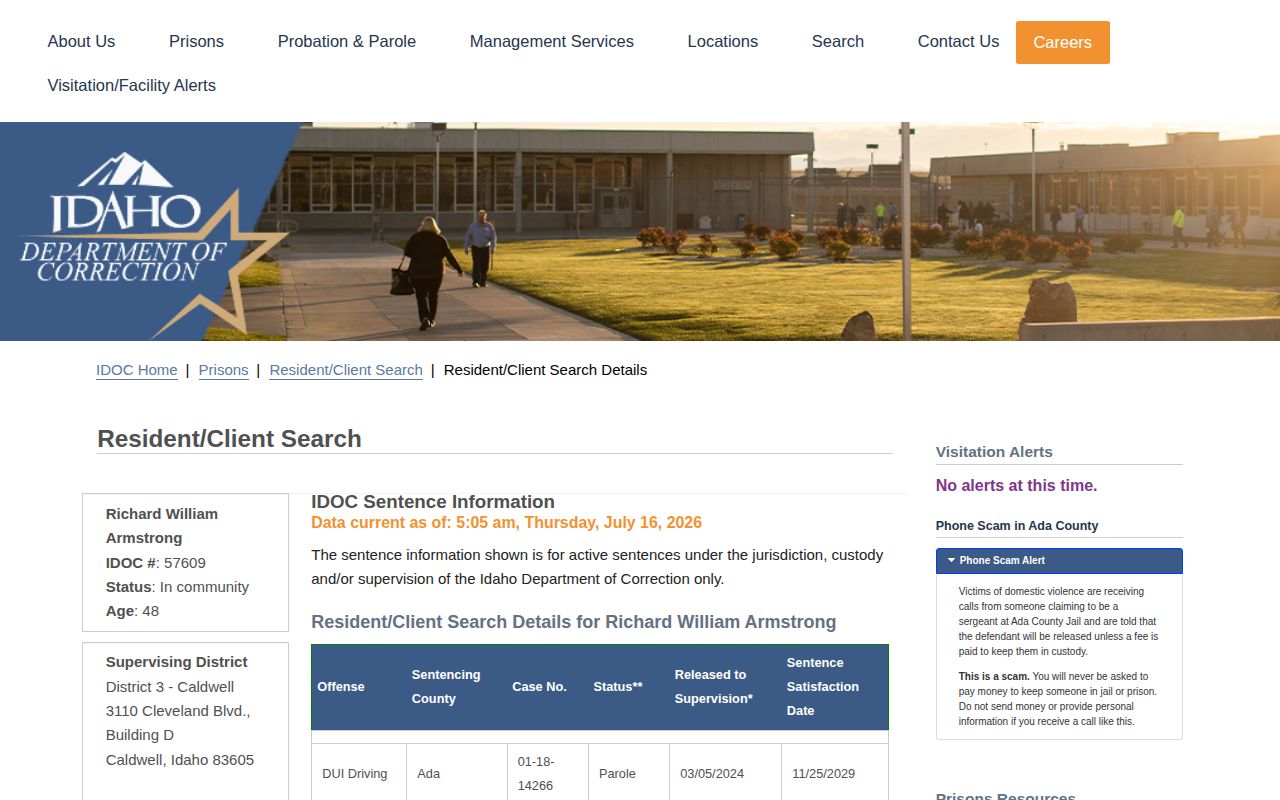
The matched detail should still be checked against the displayed District 5 contact because IDOC warns that status data can change.
Minidoka Supervision Through District 5
IDOC Probation & Parole District 5 covers Minidoka along with Blaine, Camas, Cassia, Gooding, Jerome, Lincoln, and Twin Falls counties. The main office is in Twin Falls. A Burley satellite office is close to the regional jail, but the correct contact is the office named on the person's IDOC detail, not whichever address seems nearest.
IDOC Probation & Parole District 5
Main office
731 Shoup Avenue West
Twin Falls, ID 83301
208-736-3080
Burley satellite
1354 Albion Avenue
Burley, ID 83318
208-878-2530
Fax: 208-878-2534
The official District 5 page confirms Minidoka coverage and current contacts.
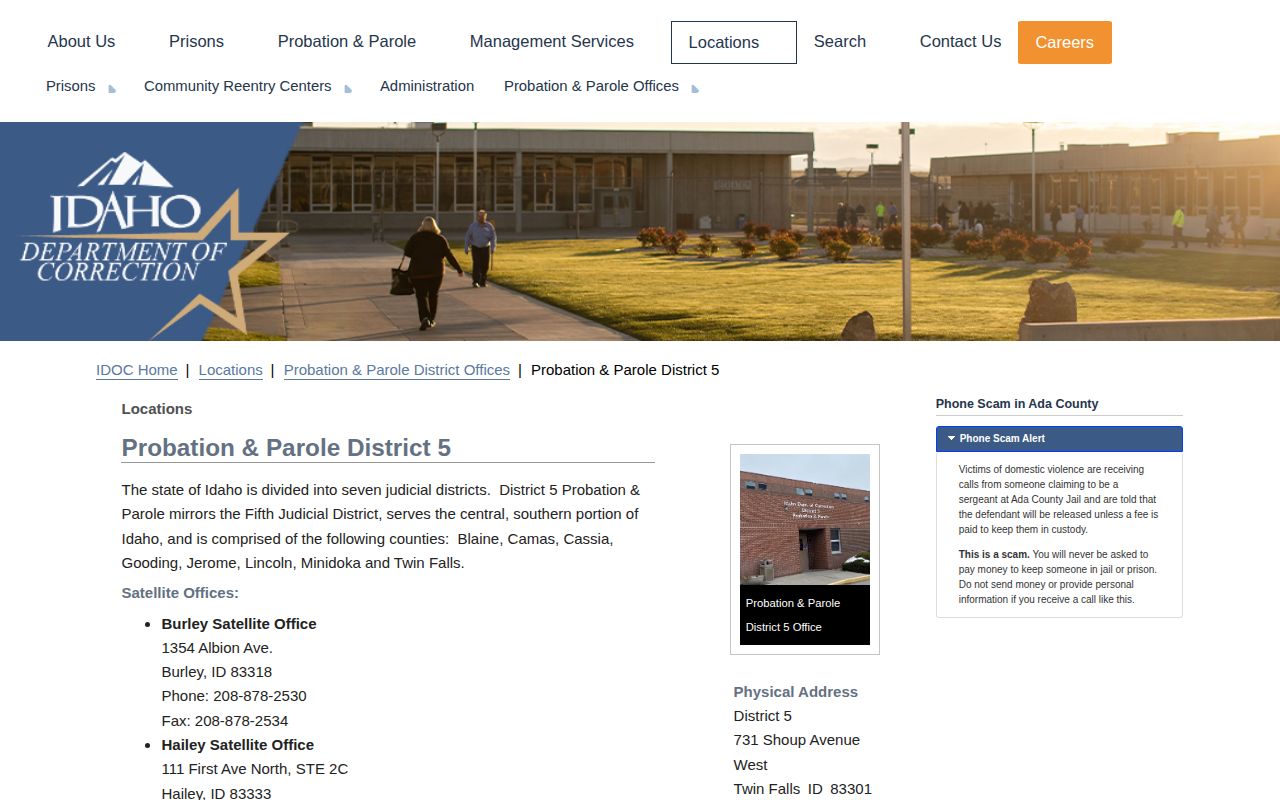
This district listing is the local routing source after the IDOC person record identifies active Minidoka County supervision.
District staff can confirm the office of record and explain which public channel applies. They are not the source for a Mini-Cassia booking or physical release time. Those facts remain with the regional center or the records custodian.
The regional arrangement makes this split important. A Minidoka arrest is booked at Mini-Cassia in Cassia County, while District 5 can supervise a later Minidoka County probation or parole case. The jail, court, and IDOC records describe related but distinct stages. A caller should give the IDOC number and case number when available so staff can distinguish a community-supervision question from a jail-record question.
Note: The Burley satellite and Mini-Cassia are separate offices even though both addresses use Albion Avenue.
Minidoka Supervision Terms and Violations
Supervision conditions come from the court, Commission action, and the individual supervision record. They can include reporting, approved residence or travel, required programming, and compliance with court or Commission directions. The public IDOC detail does not replace the person's signed conditions. A violation can lead to added action, a warrant, or return to custody, but it should not be inferred from silence or a stale page.
Idaho VINE can send movement and status notices for an enrolled IDOC record. It is an alert system, not a complete supervision file. A notice should prompt a check of IDOC and the supervising office. County and IDOC VINE feeds are distinct, so a Mini-Cassia custody alert does not by itself establish the status of a state parole or probation case.
- Parole
- Community placement after incarceration, subject to Commission authority and IDOC supervision.
- Probation
- A court-ordered community sentence supervised by IDOC.
- Absconder
- A supervised person alleged to have stopped required contact or left supervision without approval.
- Discharge
- The formal end of the sentence or supervision authority, not merely a move into the community.
Minidoka Warrants Are Not Releases
An IDOC result may display Active Bench Warrant. That label is not normal, compliant release status. It also does not prove the person is in custody. Report the field as shown, then use the displayed record and an official office for current confirmation. IDOC Fugitive Recovery maintains a selective Most Wanted list, but absence from that list means little because it focuses on a subset of fugitives.
Cassia County also publishes an Outstanding Warrants page. It is separate from the live roster and is not a Minidoka County recent-release list. A warrant can coexist with absence from the jail. IDOC Fugitive Recovery can be reached at 208-658-2167 for its official channel, while urgent concerns should be directed to the appropriate agency.
Do not turn roster absence into a warrant claim. The most accurate statement identifies the source, date checked, and exact status wording.
A selective list has limits by design. IDOC Fugitive Recovery focuses its public Most Wanted material on certain people with violent, aggravated, or sexual histories. A person who does not appear there may still have an IDOC warrant status in Resident/Client Search. Conversely, an old booking or warrant page does not establish that a person remains wanted today. Current confirmation must come from the responsible agency.
Minidoka Release Reentry Support
The Mini-Cassia Criminal Justice Center describes education, substance-abuse work, and rehabilitative community-based programs as part of its philosophy. It does not publish a named local release navigator or a stated release-day intake service. Families should not assume that a specific ride, placement, or appointment will be arranged through the jail.
The documented statewide fallback is IDOC Reentry Services. Its reentry liaison can be reached at 208-605-4771 or reentryliaison@idoc.idaho.gov. This resource fits people moving through IDOC custody or supervision. It should not be presented as proof that a Mini-Cassia detainee is on parole or probation.
For an active client, the District 5 office named on the record remains the best local starting point. Contact before travel or before relying on a program description.
Note: Published reentry resources support planning, while the IDOC record and supervising office establish the actual supervision status.
Minidoka Supervision and Discharge
Release to supervision is not the end of IDOC jurisdiction. A parole record may show Released to Supervision first and a later Sentence Satisfaction Date. Once parole is complete, the Idaho Commission of Pardons & Parole issues formal discharge notice, known as a Gold Seal, through the last supervising district. The Commission says processing can take up to a month.
For probation, use the court case and IDOC status together. The court remains the source of the sentence and later orders, while IDOC shows the supervision record. If the public result later says Discharged [date], preserve that exact label. Do not rewrite it as a prison exit if the person had already been in the community.
Commission schedules and decisions can explain parole events, but a hearing date or tentative grant is not proof that release occurred. The official weekly hearing schedule can change, and later IDOC community status is stronger proof of placement.
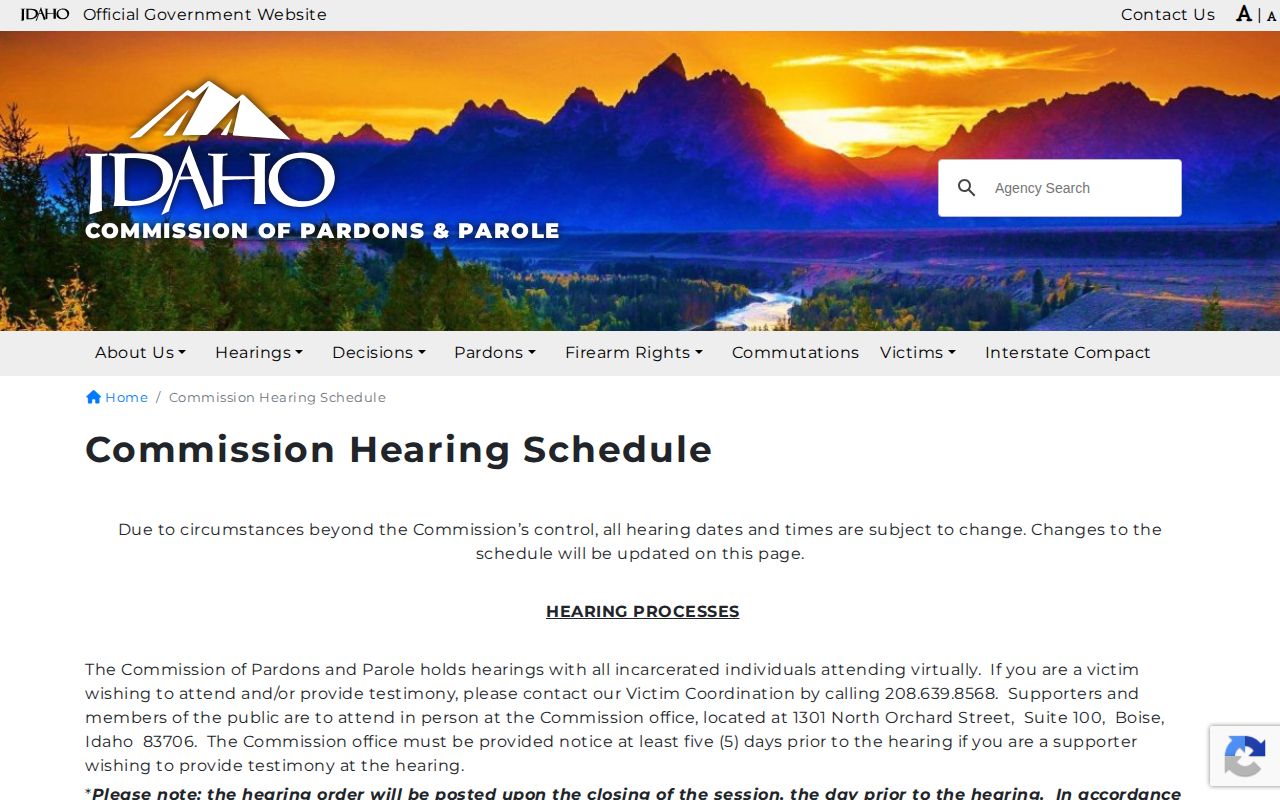
The schedule supplies hearing context, while District 5 and the resident/client record verify the resulting supervision status.