
Minidoka County Released Inmates
Adults arrested in Minidoka County are housed at the Mini-Cassia Criminal Justice Center in Burley. Cassia County operates the joint facility and hosts its roster, while the criminal case can remain a Minidoka case. A person who leaves the building normally drops from the live roster. That change does not reveal whether the person entered the community or moved to another custodian.
A release record should identify the booking episode, physical custody end, disposition, and destination. Bond, recognizance, court order, dismissal, time served, sentence completion, probation, IDOC commitment, another county's warrant, and ICE or U.S. Marshals handoff are distinct outcomes. The facility may use its own codes, so request the public legend or plain-language meaning.
- Release
- The end of a specific custody episode, which may lead to the community or another custodian.
- Time served
- Release after credited confinement satisfies the ordered jail term.
- Parole
- Community placement after prison under Commission authority and IDOC supervision.
- Probation
- A court-ordered community sentence supervised by IDOC.
- Discharge
- The end of sentence or agency jurisdiction, not merely prison departure.
Minidoka County Release Types
The next search depends on the exit type. A local community release remains tied to the Mini-Cassia custody entry and Minidoka court case. State commitment sends the search to IDOC. Immigration or federal transfer requires the matching federal system. A probation placement can occur without a state-prison stay.
| Exit type | Meaning | Next proof |
|---|---|---|
| Bond or court order | Release authorized in the local case | Jail release entry plus signed order |
| Time served or dismissal | Local custody basis ended | Custody timestamp and disposition |
| IDOC commitment | Transfer to state custody | IDOC In custody result |
| Parole or probation | Community supervision | IDOC In community detail |
| ICE or USMS transfer | Continued custody under another authority | Agency-specific locator or record |
Why did the name vanish? Roster absence only proves that the person is not displayed. Call Mini-Cassia and ask whether the booking ended in community release or transfer.
Minidoka County Release Record Fields
The public roster exposes booking ID, name, demographics, booked time, days in jail, inmate type, photo, charges, agency, case, and bond. It does not expose release date, release time, reason, receiving agency, or a released flag. The missing fields belong in a focused custody-record request.
| Field | What it establishes |
|---|---|
| Booking ID and date | The exact custody episode |
| Actual release date and time | When physical custody at Mini-Cassia ended |
| Release disposition or type | Why the episode ended |
| Community release or transfer | Whether another custodian took control |
| Receiving authority | IDOC, ICE, USMS, another county, or other destination if nonexempt |
| Booking photograph | The image tied to that episode |
Identity must be tied to the episode. Use date of birth or birth year, arrest date, arresting agency, case number, charge, and booking ID. A same-name match is weak. Release time can matter when comparing a same-day court order, VINE alert, and jail log.
Request Minidoka Release Records
Because the jail is jointly operated, call Mini-Cassia at 208-878-1000 and ask which office holds the custody-release series. Minidoka Sheriff Records handles Minidoka arrest records at 724 H Street in Rupert, phone 208-434-2326, Monday through Friday from 8:30 a.m. to 5 p.m. Cassia Sheriff Records can be reached at 208-878-1107 when Cassia holds the jail log.
- Gather the full name, birth date if known, booking or arrest range, agency, case, and booking number.
- Ask for the booking sheet and custody-release entry, actual time, disposition, destination, and code meaning.
- Use the Minidoka public-record request route or the custodian identified by Mini-Cassia.
- Request electronic copies, an advance estimate, and segregable nonexempt portions if material is withheld.
- Use the IDOC records portal separately when state release, supervision, and discharge dates conflict.
No local release-specific fee is published. Under the state framework described by the Attorney General, response periods can extend to ten working days for Idaho residents and 35 for nonresidents. For Idaho residents, the first two processing hours and 100 pages are free, then permitted charges track actual qualified labor. Exemptions and volume can affect the response.
Does Minidoka Bond Mean Release?
Mini-Cassia shows bond by charge, not one promise that the door will open. A zero-dollar line, one bonded charge, or one posted amount does not resolve all charges, holds, warrants, or sentenced status. Confirm every line and the court's authority with the center and court.
The official roster is useful for the charge and bond context, but its fields stop short of release proof. A court order explains legal authority. The jail custody entry records the physical exit after identity, detainer, property, and transport checks.
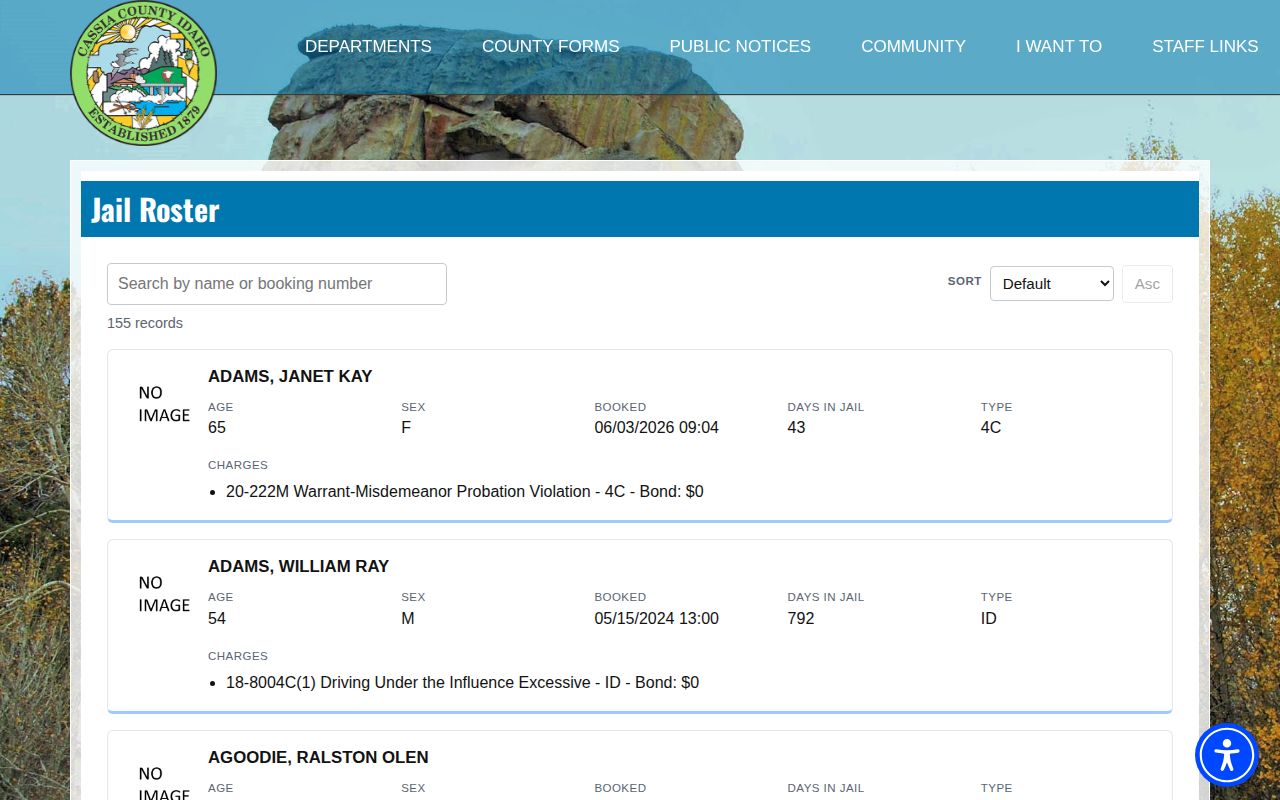
The roster image illustrates why booking and bond data must be paired with a release record.
Why Minidoka Releases Need Verification
A June 11, 2024 joint-powers snapshot counted 123 people: 54 Cassia, 24 Minidoka, one Lincoln, one ICE, 35 IDOC, five USMS, and three courtesy prisoners. These are dated figures, not a current census or capacity claim. They show that one building serves several legal custodians.
The practical rule is simple: confirm exit from the building, then confirm destination. A state, federal, immigration, or courtesy-hold transfer is not community release even when the local name disappears.
Search Minidoka County Released Inmates
Start with the last known custody system instead of searching every database. A local arrest begins with Mini-Cassia. State commitment begins with IDOC. A federal sentence belongs in BOP, while immigration custody belongs in ICE ODLS. The court and VINE corroborate events but do not replace the physical custody log.
- Search the Mini-Cassia roster by name or booking number. If listed, the person is displayed in current custody, subject to lag.
- Use Recent Bookings to recover the booking ID, case, charge, and photo, never as release proof.
- Call the center and ask release versus transfer, actual date and time, disposition, and receiver.
- Search Minidoka iCourt for the signed order or judgment supporting the legal event.
- Follow IDOC, ICE, USMS/BOP, or another county when the center reports transfer.
- Use a focused record request when no online source supplies the physical-exit facts.
IDOC Search for Minidoka Releases
The IDOC Resident/Client Search covers state jurisdiction, not an ordinary jail bond release. Search by surname and given name or IDOC number, then compare birth year, number, sentencing county, and case. Partial surname searches need two characters and partial IDOC numbers need three digits.
| IDOC field | Meaning |
|---|---|
| In custody | Held by IDOC |
| In community | Under probation or parole supervision |
| Active Bench Warrant | Warrant status, not routine release |
| Discharged [date] | IDOC jurisdiction ended on the shown date |
| Released to Supervision | Most recent community-placement date |
| Sentence Satisfaction Date | Sentence endpoint, not always prison exit |
The search warns that data changes and updates daily. A discharged result retains name, status, and date but may omit completed conviction details. Use iCourt for the Minidoka conviction and IDOC records when the physical prison-exit path matters.
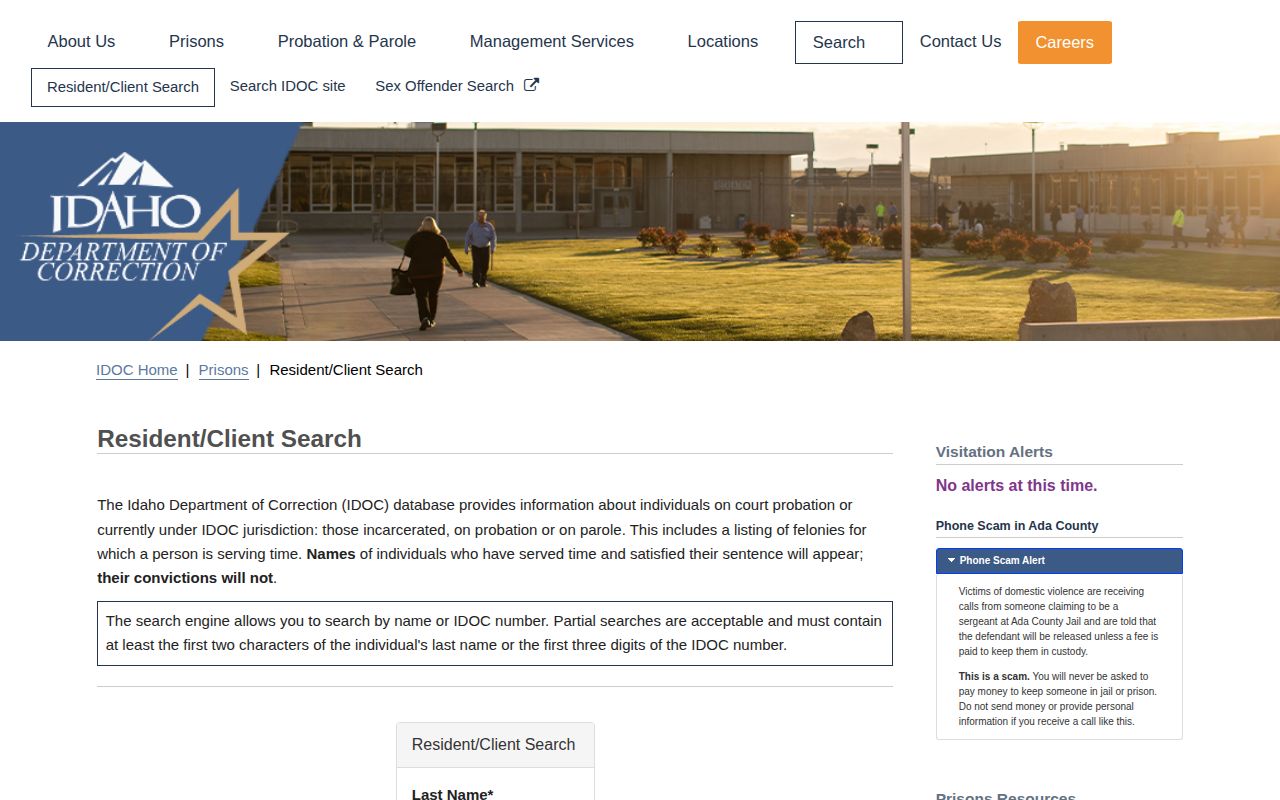
The official search image shows the state fields and limits that guide an accurate identity match.
Minidoka Release Court and Jail Split
Minidoka adults are physically booked in Cassia County under the joint-powers arrangement, while the originating case can remain in Minidoka County within the Fifth Judicial District. Search Cassia's jail tools and Idaho iCourt Smart Search with Minidoka case identifiers.
A public court case can show party, charge, bond, disposition, register events, financial data, and available documents. Look for the signed order supporting bond, dismissal, time served, probation, or commitment. The order explains authority, while the jail record supplies the actual door time. A sealed or shielded case may produce no public result.
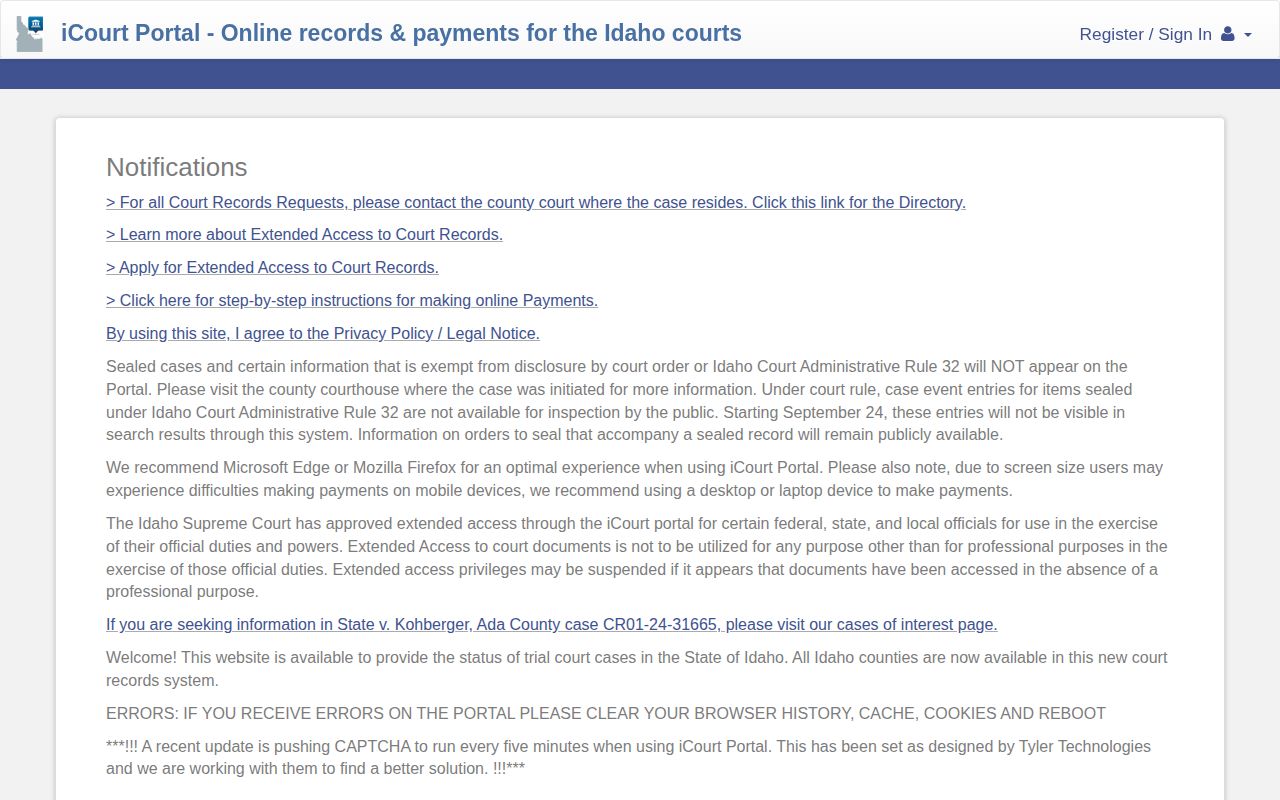
The court portal helps reconcile the Minidoka case with the Cassia-hosted custody record.
Minidoka Release Reentry Resources
Mini-Cassia describes education, substance-abuse, and rehabilitative community-based programs, but it publishes no named local release navigator. Do not assume a specific ride, placement, or appointment is arranged at release.
The documented statewide fallback is IDOC Reentry Services, with the reentry liaison at 208-605-4771 and reentryliaison@idoc.idaho.gov. This channel is relevant to IDOC custody and supervision. District 5 handles Minidoka parole and probation, which can be verified through the Minidoka supervision page.
Minidoka Release or ICE Transfer?
ICE's 2024 inspection identifies Mini-Cassia as co-owned by Minidoka and Cassia, operated by Cassia Sheriff, and used for ICE detainees since 1993. Local minutes also separate ICE, USMS, and IDOC populations. Transfer is therefore a real alternative to community release.
ICE ODLS accepts an A-number plus country of birth or exact name plus country of birth. It covers current detainees and some releases within a limited window, but exclusions and lag make no-result inconclusive. U.S. Marshals prisoners require the federal docket, housing jail, and later BOP locator. USMS historical records may require FOIA. Never use BOP first for an ordinary Minidoka booking.
Where Minidoka Inmates Are Released
The Rupert law-enforcement building at 724 H Street once contained the adult jail. After Mini-Cassia opened in Burley, the old building housed the sheriff and juvenile detention. It remains the correct address for Minidoka Sheriff Records, but it is not the adult release door.
No official source publishes a release door, waiting area, transit arrangement, property rule, or set daily release time at Mini-Cassia. Call 208-878-1000 before travel. The lack of published logistics should not be filled with an estimate.
Minidoka Release Records After Shielding
Idaho Clean Slate shielding is not destruction. Under Idaho Code §67-3004(11), an eligible nonviolent, nonassaultive record may be petitioned for public shielding after at least five years from completion of the whole sentence, including supervision, fines, and restitution. Eligibility is limited, and public disappearance after an order does not mean the custody event never occurred.
Qualifying arrest-record expungement under subsection (10) is separate and can apply where no case was filed within the stated period, all incident offenses ended in acquittal, or all charges were dismissed. It requires an application and records. Neither remedy promises automatic deletion of every booking photograph or jail release log.
The Idaho Clean Slate source explains the official process.
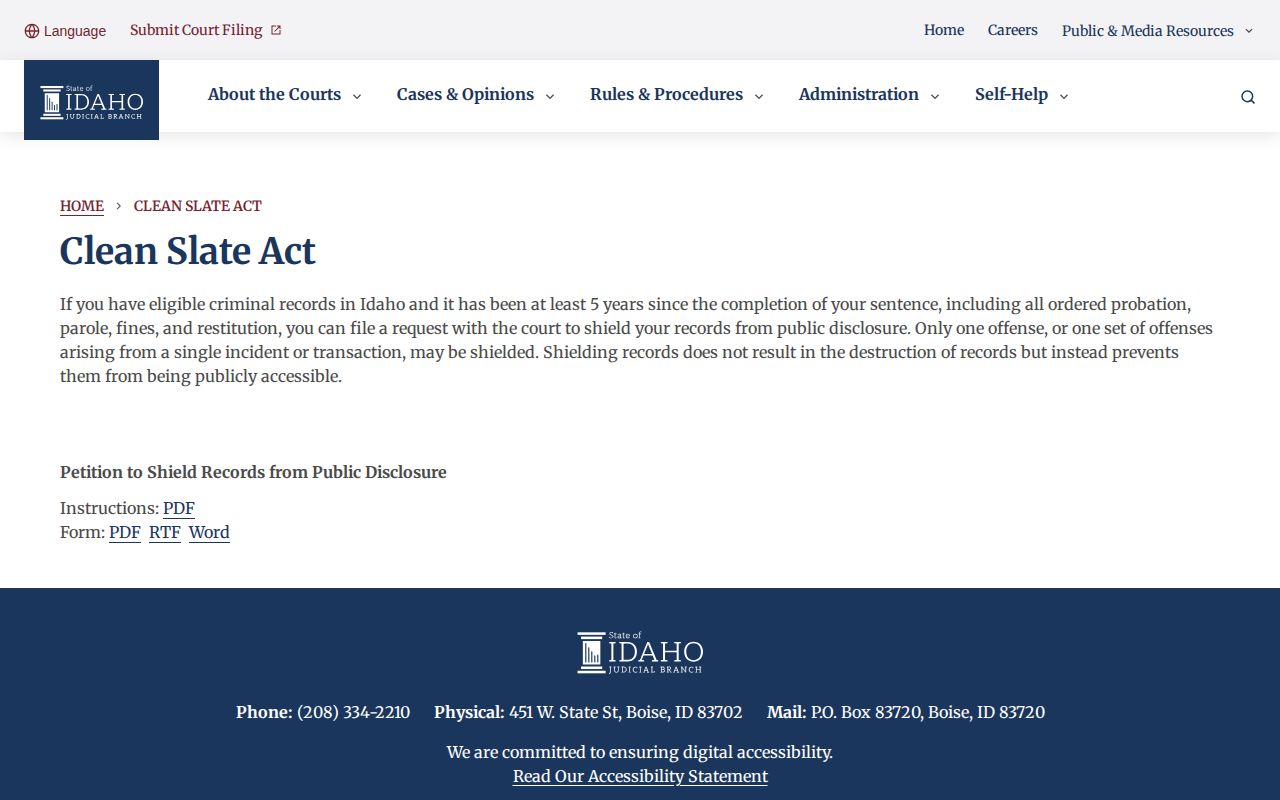
The source helps explain why a public no-result must remain inconclusive.
Minidoka County Recent Release Search
No verified official 24-hour or 72-hour released-inmate feed exists for Mini-Cassia. Cassia publishes a live roster and a long-range Recent Bookings page. Recent Bookings contains substantially the same identity, booking, charge, bond, and photo data, but no release date, type, receiver, or release-window field. Its database reached far beyond three days during research.
The official explanation says the database updates every 24 hours and recent changes may not appear. That cadence is not a release window. For an event believed to have happened today, call the center and request the custody entry. Over several days, add the court register, VINE event, and the proper receiving-agency search. The Minidoka 24-hour release check gives the exact same-day fallback.
Minidoka Release Alerts and Supervision
Idaho VINE offers phone, text, and email movement or status notices. Select Idaho, match the exact person and custody source, then register on the verified record. County and IDOC feeds are operationally distinct, so selecting the state does not settle whether the Mini-Cassia or IDOC record is correct. A release or movement notice should be checked with the agency.
For post-release supervision, IDOC In community plus the sentence-level Parole or Probation label, Released to Supervision, and supervising district form a coherent record. District 5 serves Minidoka. At parole completion, the Commission issues formal discharge notice through the last district. A Commission hearing or tentative date is not proof that placement occurred.
Minidoka Released Versus In Custody
Each system answers a narrow question. Keeping scope visible prevents a roster, court order, alert, or registry entry from being stretched beyond what it proves.
| System | Use | Limit |
|---|---|---|
| Mini-Cassia roster | Displayed current jail custody | Absence does not prove release |
| Custody-release entry | Physical exit time and disposition | Must be requested if not online |
| IDOC | State custody, supervision, discharge | Not a local bond-release source |
| iCourt | Judicial basis and disposition | Order time may differ from exit time |
| VINE | Movement and status alert | Not a durable certified history |
| BOP or ICE | Agency-specific federal custody | No-result does not rule out other custody |
The Idaho registry is limited to people with a registration duty and cannot establish a release date. ISP warns that biographical matching is not conclusive. Use the jail, IDOC, court, or federal custodian for release chronology.
Minidoka County Release Systems
Each facility link identifies a different record route. Mini-Cassia is the adult regional jail. Minidoka Sheriff is the arrest-record office and former jail site. Juvenile detention has restricted records and is not an adult search path. IDOC covers state prison and District 5 supervision. BOP, ICE, and U.S. Marshals sources apply only to their own custody.
- Mini-Cassia Criminal Justice Center
- Minidoka County Sheriff
- Mini-Cassia Juvenile Detention Center
- Idaho Department of Correction
- Federal Bureau of Prisons
- ICE Custody at Mini-Cassia
- U.S. Marshals Service
A correct conclusion names the last custodian, the record field, and the exact event. It never calls someone released solely because a roster changed.